Wednesday, 14 March 2012
Thursday, 8 March 2012
Young Miniatures - British Paratrooper, Northwest Europe, 1944
.
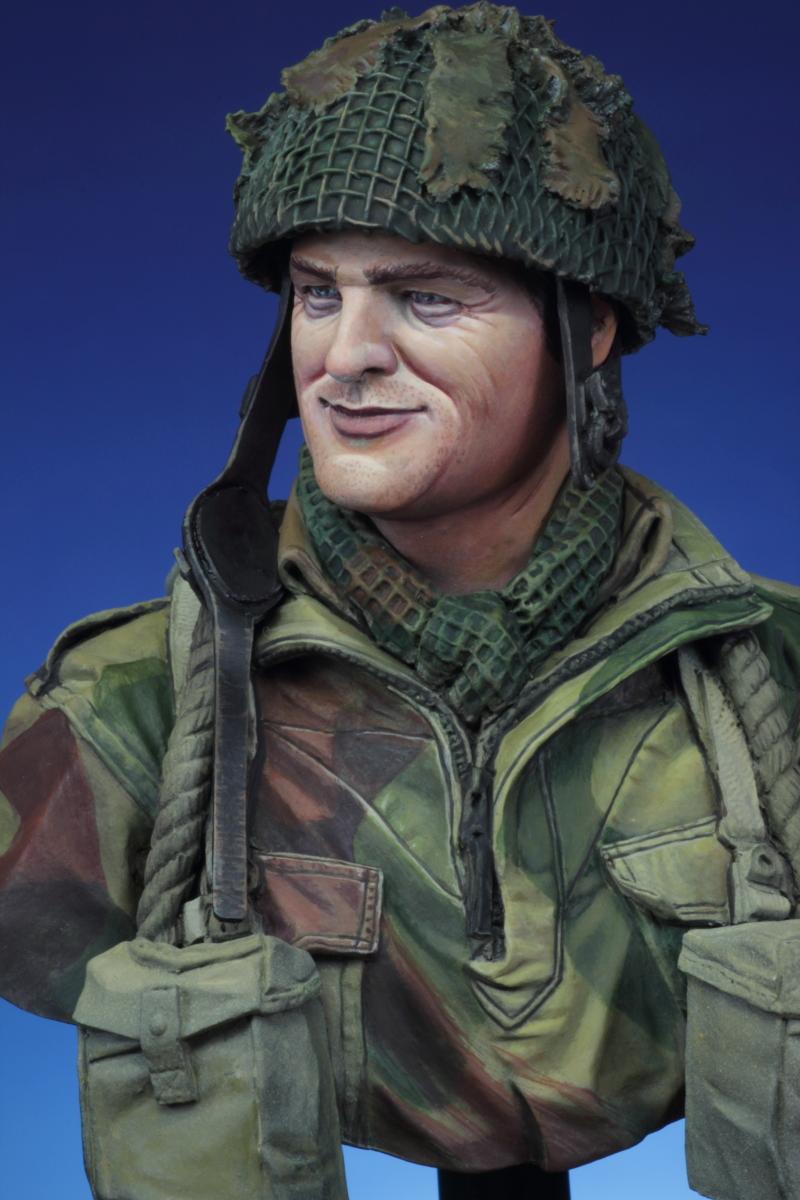
Still on a roll with the painting streak, I've been once again offered another irresistible assignment to paint the box art for Young Miniature's upcoming offering - a WW2 British paratrooper sculpted by Young himself. I am sure that many will agree, that Young deserves kudos for taking up the courageous gamble to abstain the trial and tested commercial viability of WW2 Germans subjects for a WW2 Allied offering instead.In retrospect, it seems that Young does have a penchant for WW2 airborne troops -with his past releases of Fallschirmjagers, US 82nd and 101st Airborne. It would seem that this upcoming release will complete the full collection of Allied airborne troops operating on D+1. Perhaps he could be so kind as to consider also packaging this British Paratrooper together with his previously released 101st and 82nd Airborne busts as a complete special D-Day anniversary collectors set.
The kit contains 9 parts - including a bonus British airborne badge. It definitely looks the part of a commemorative tribute to the British airborne in WW2 when pieced together as a complete display. Another distinguishing aspect of this portraiture would be Young's recent shift in the depiction of an archetypical "good looking" face to that of slight caricature and character personality. As far as stereotypes goes, one could readily assume that this bloke is a familiar face in one of those English bars chugging down a pint of ale after a rugby match.
Regrettably, I was unable to spare the additional effort to provide a blow by blow pictorial account of the painting process - especially on the camouflage for the Denison smock. Fast forward here is a week's intermittent effort. Jo Sonja paints were used exclusively up to this point and hopefully I'll be able provide some color notes here at my earliest possible free time.
Cheers,
Calvin
Tuesday, 6 March 2012
Young Miniatures - Unterfeldwebel, Kampfgeschwader 54, 1940
.
As a final wrap up to this painting assignment, here are some of my personal shots of the completed bust. Cheers,
Calvin
Sunday, 4 March 2012
Rendering the Kapok Vest
This installment recounts the wet-on-wet technique employed for a localized rendering of the kapok vest towards the build-up of chroma for the highlights and shadows.
The same process was repeated using Naples Yellow for the highlights.
In summary, this pretty much concludes the techniques applied in the painting of this masterful sculpt by Mike Good. On accounts of the high quality casting, the ease of assembly and beautiful design, I must say that it has been a fun filled experience tackling this highly refreshing WW2 German subject matter. I do hope that the pick-up for this piece will be encouraging for Young Miniatures to warrant another collaboration with Mike Good in the near future.
Cheers,
Calvin
Wednesday, 29 February 2012
Painting the Helmet
Labels:
Modelling Tutorials,
Young Miniatures - Unterfeldwebel Kampfgeschwader 54 1940
Posted by
Calvin Tan
at
19:34
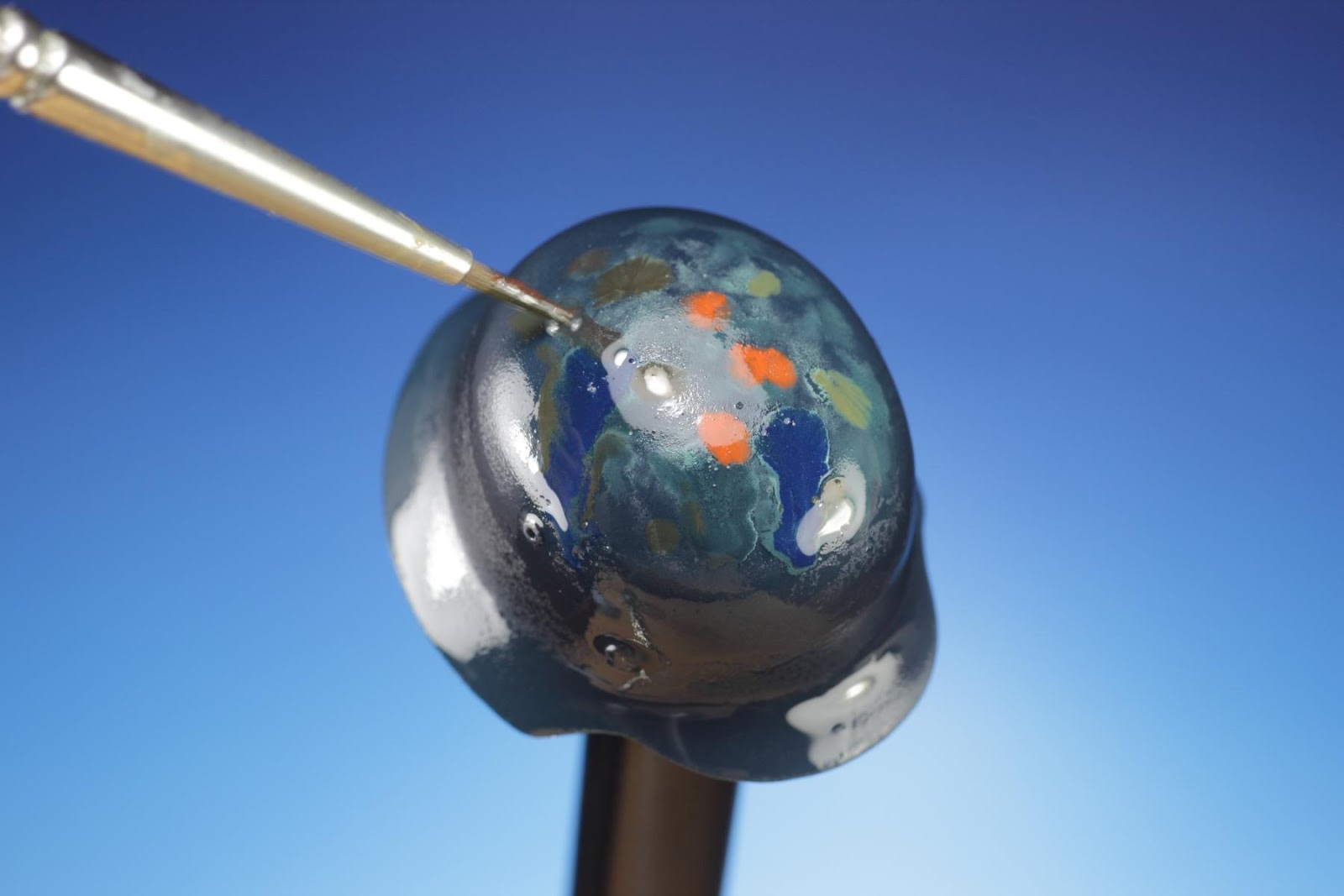
Coinciding with the leap year, this installment illustrates the wet-on-wet approach used to render the Luftwaffe helmet.
To enhance the spread of paint and diffusion of color, the surface is moisturized with a spray of the retarder and water solution before an intermediate highlight color mix of Storm Blue and Titanium White is applied.
Some processes was repeated over a couple times in the single session before arriving to the satisfactory result. Finally, the helmet decal and Luftwaffe eagle was painted in by hand completing the paintwork for the helmet.
cheers,
Calvin
Monday, 20 February 2012
Young Miniatures - Unterfeldwebel, Kampfgeschwader 54, 1940
.
Moving on to the rest of the bust, the backing for the parachute bag is undercoated with Gunze Sanyo Lacquer-based silver paint.
It is painted with a color mixture of Hookers Green, Cadmium Orange and Carbon Black and set aside to dry.
A solution of water and retarder is applied and the chafe effects were
created by scratching the paint off with a toothpick.
The seams on the sleeves are highlighted with Naples Yellow and deep shadows outlined with a mixture of Hookers Green, Cadmium Orange, Storm Blue and Black. The shoulder patch was undercoated with a mix of Raw Sienna, Earth Brown and Naples Yellow. Storm Blue was added to the mix, providing the colors for shadow.
The gull wings on the shoulder patch are undercoated with a mixture consisting of Naples Yellow, Storm Blue and Titanium White.
The high points of the gull wings are highlighted with Titanium White, completing the painting of the shoulder patch.
The Sfumato technique was employed to mediate the stark boundaries between intermediate colors. The diffused effect is achieved by evenly "scrubbing" on a very small amount paint across the surface producing a soft and faint impression of the color.
This is relatively easier to accomplish with oils with its slow drying
and thicker paint body.
With
acrylics, the drying is prolonged with the addition of the paint
retarder. The retarder also coagulates the paint
as it dries, giving it the thick buttery paint body ideal for this purpose.
The surface is prepared with a retarder and water solution.
Next, a small amount of intermediate shadow color is brushed on and worked around in a scrubbing motion, producing a cloud like effect.
The same procedure follows towards the application of the highlights.
The parachute harness was painted with a mix of Raw Sienna, Naples Yellow, Hookers Green and Titanium White. Subtle tonal variations are created with light washes of Earth Brown and Storm Blue.
Cheers,
Calvin
Subscribe to:
Posts (Atom)